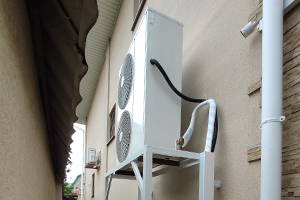
Heat pumps have been used in the Ukrainian climate control market for quite some time. A huge number of homeowners have experienced the effectiveness of such heaters firsthand.
The advantages of heat pumps as a source of heating and cooling are widely covered, for example: their efficiency, environmental friendliness, and most importantly, their cost-effectiveness.
But how is this achieved, what physical processes occur during the operation of a heat pump? And the most important question is: how can you get efficient heating from cold air outside, or vice versa - coolness in the house when the temperature outside is over 30 ℃?
Below we will briefly answer these questions.
Heat pumps are distinguished by the following parameters
by design (in a single housing or separately);
by the source of heat carrier (air, geothermal, etc.).
A heat pump is equipment that consists of four main units and a special refrigerant that transfers heat or cold from one unit to another.
The refrigerant must have certain parameters, such as
low boiling point
heat capacity
In household appliances, such refrigerants are various freons.
Let's take a look at how an air-to-water heat pump works. The heat source of such a heat pump is the ambient air. The heat pump unit that takes heat from the outside air is called an evaporator. In the evaporator, the liquid refrigerant (hereinafter referred to as freon), which has a temperature lower than the environment, is heated and evaporates, turning into a gas. For more efficient heating of freon in the evaporator, its design provides for the installation of a fan, which allows more outside air to pass through the evaporator per unit of time.
The compressor is considered to be one of the main units of the heat pump. This is a special unit that compresses heated gaseous freon through the use of external energy. As a result of compressing freon in the compressor, it heats up even more. Also, as a result of the compressor's operation, freon moves along a closed circuit from one heat pump unit to another. After the compressor, the superheated gaseous freon enters the condenser unit, where it releases heat to the existing water heating system, as a result of which the temperature of the freon decreases and its partial condensation occurs.
The dimensions of the condenser and evaporator are calculated by the heat pump manufacturer based on the compressor capacity. For the convenience of selecting heat pumps for heating systems, each manufacturer has a whole line of heat pumps of different capacities.
After the condenser, the cooled freon flows to the expansion valve. As it passes through the expansion valve, the freon finally condenses and is further cooled. Then the liquid cold freon enters the evaporator and the circuit is closed. For greater efficiency of the heat pump, each unit automatically adjusts the freon parameters depending on the outside air temperature and the temperature of the heating medium in the heating system. If the building's heating system is designed and installed with the possibility of air conditioning the premises with fan coil units or cold walls, the heat pump automation switches its operation on request and the excess heat from the room is transferred to the environment with the help of freon.
Due to the fact that a heat pump does not generate heat or cold,
but only transfers them from the source to the consumer, it has high energy efficiency. The coefficient of conversion of 1 kWh of electricity to heat (COP) for heat pumps exceeds 3.5, and in some operating modes it can reach higher values. This means that for 1 kWh of electricity consumed, you will receive 3.5 kW of heat, which is 350%.
We sincerely hope that our article has helped you to understand the principle of the heat pump. Find more - herearticles about heat pumps here. If you have any questions or are interested in designing and installing a climate system in your home, Reneco specialists will be happy to help you.