PVsyst results
As a result of applying the initial data in the PVsyst 6.8.0 software package, the results shown in the table were obtained.
SolFrac (Solar Fraction) – “solar component”. Presented as a coefficient showing the amount of solar energy in the energy balance of the object. Value “1” - energy needs are fully provided by solar energy.
This equipment configuration, with a given hourly energy profile of the load, is capable of providing a solar component coefficient of “1” in the following months: May, June, July, August.
In the annual energy balance, the solar component is provided with a coefficient of 0.77 (77%). This means that to provide the missing amount of energy - 0.23 (23%) of the total amount, a guaranteed power source can be used.
|
GlobHor kWh/m2 |
GlobEff kWh/m2 |
E_Avail kWh/m2 |
EUnused kWh |
E_Miss kWh |
E_User kWh |
E_Load kWh |
SolFrac |
| January |
28.4 |
43.3 |
0.0 |
198.5 |
136.3 |
334.8 |
334.8 |
0.407 |
| February |
47.1 |
61,4 |
0.0 |
128.0 |
174.4 |
302.4 |
302.4 |
0.507 |
| March |
86.3 |
101.5 |
26.0 |
63.7 |
271.1 |
334.8 |
334.8 |
0.810 |
| April |
133.8 |
142.1 |
97.7 |
16.9 |
307.1 |
324.0 |
324.0 |
0.948 |
| May |
180.1 |
501.3 |
154.5 |
0.0 |
334.8 |
334.8 |
334.8 |
1.000 |
| June |
191.8 |
496.7 |
157.6 |
0.0 |
324.0 |
324.0 |
324.0 |
1.000 |
| July |
193.1 |
493.4 |
142.3 |
0.0 |
334.8 |
334.8 |
334.8 |
1.000 |
| August |
171.0 |
490.8 |
143.0 |
0.0 |
334.8 |
334.8 |
334.8 |
1.000 |
| September |
116.9 |
390.0 |
74.3 |
13.3 |
310.7 |
324.0 |
324.0 |
0.959 |
| October |
74.6 |
301.7 |
13.3 |
64.5 |
270.3 |
334.8 |
334.8 |
0.807 |
| November |
31.2 |
132.5 |
0.0 |
186.8 |
137.2 |
324.0 |
324.0 |
0.424 |
| December |
22.9 |
117.3 |
0.0 |
226.6 |
108.2 |
334.8 |
334.8 |
0.323 |
| Year |
1277.2 |
3984.4 |
808.9 |
898.3 |
3043.7 |
3942.0 |
3942.0 |
0.77 |
Selected equipment and output
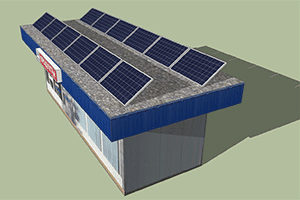
Photovoltaic modules. Polycrystalline photovoltaic modules Suntech STP275-20/Wfw 5BB were selected in the amount of 12 pieces, with a total power of 3.3 kW (STC). The productivity of the PV field is 3.3 kW, with an optimal angle and azimuth, in the summer, on average, is 14.85 kWh, which is enough to cover the energy needs of the facility for a given period. The angle of installation of the FEM to the horizon is assumed to be 35°, which corresponds to the optimal angle at a given latitude.
Autonomous solar inverter. The IMEON 3.6 hybrid inverter was selected as an autonomous inverter, with a power from 3 kW to 6 kW for 3 s, a power of photovoltaic modules up to 4 kW, a charger voltage of 48 V, a maximum charge current battery 60 A and discharge 80 A. There is the possibility of remote monitoring.
Rechargeable battery. OPzS traction elements with a capacity of 400 Ah (C5) were chosen as a battery - this is the capacity at a 5-hour discharge, indicated mainly by
only for traction elements. For other types of batteries, as a rule, a 10-hour discharge capacity (C10) is indicated. The C10 capacity of these cells is approximately 440 Ah. Element voltage is 2V. The voltage of the inverter charger is 48V. The amount of stored energy in 24 elements is 21 kWh. The number of deep discharge cycles (75% DOD) for OPzS type cells is about 1500. To achieve a longer operating mode, about 3000 cycles, it is recommended to choose a battery with a larger capacity to achieve a discharge depth per cycle (day) of 50-60%. This condition is fully satisfied by the selected capacity (10.8 kW*h/0.6=18 kW*h<21 kW*h).
Conclusion. The system fully satisfies the Customer’s conditions, and even provides a longer power supply time for the critical load (24 hours), namely freezers, in the amount of 3 pcs. during the summer months. At all other times, to produce energy not provided by the sun, it is necessary to use a guaranteed power source: for example, a diesel or gasoline generator. The generator can also be used to power the hybrid inverter and recharge the batteries during cloudy days and to reach the battery discharge limit.
You can order a qualified individual calculation of a solar station by contacting Reneco specialists.